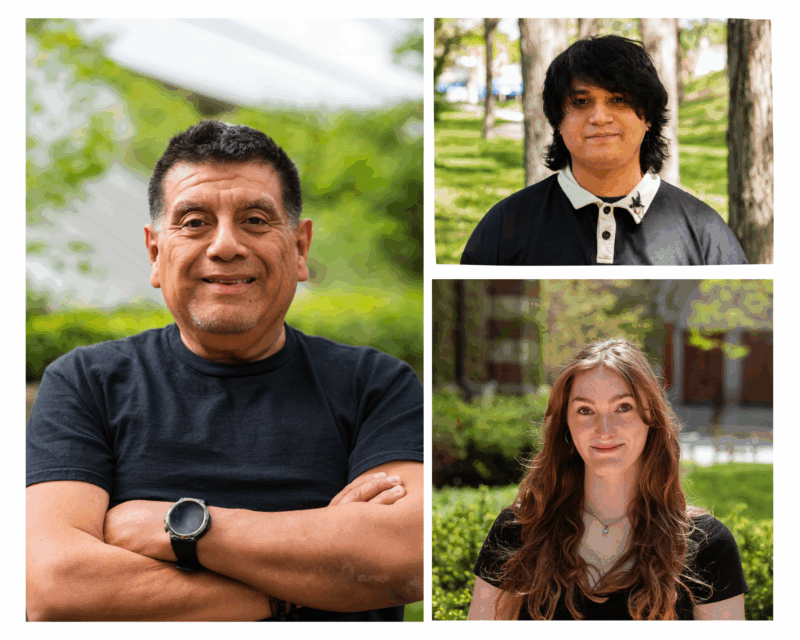
Two Wright College students and Computer Information Systems Assistant Professor Gustavo Alatta will present their work in machine learning on a national stage next month at the National Summit on Artificial Intelligence.
Dakota, Lisa, and Professor Alatta will share their work with more than 200 educators, industry leaders, and innovators to explore how AI is changing education and the workforce. This opportunity grew from Dakota and Lisa’s desire to gain more hands-on experience in their future fields. Dakota, a first-year Software Development student, joined Wright’s IT club because he wanted to do more than go to class and complete assignments. This club, now called Wright Hack Ops, is where he met Professor Alatta.
Lisa, who is studying Web Development, also joined the club in her first semester. She now serves as the president and has found that the hands-on projects give her opportunities to build skills beyond what she’s learning in class while developing her portfolio.
Dakota, Lisa, and the other IT club members initially began learning about data cleanup, Amazon Web Services (AWS), machine learning, and artificial intelligence. That led to a group project using a dataset from the Titanic. Working with Alatta, the students used passenger information to build a machine-learning model that predicts whether a person would have survived the shipwreck disaster.
Dakota and Lisa decided to take the project one step further on their own. The two took the basic model that the club created and began building a website around it. Users could enter information like their age and passenger class to see the model’s prediction of chances for survival.
Their willingness to take the project further caught Alatta’s attention. After seeing what they had built, he invited them to expand the idea, write a proposal, and consider presenting it at the National Summit. The students agreed and continued developing the project in preparation for the conference. Their presentation next month will center around this work.
“Projects like this move beyond learning AI concepts to actually building technology,” said Professor Alatta. “That’s the best way to learn.”
This project demonstrates how machine learning can be applied to other real-world problems. Dakota is also working on a separate project where a machine-learning model uses information such as age, income, and credit score to predict someone’s chances of loan approval.
“The technical aspects of all these projects have allowed me to apply what I’m learning in class to hands-on projects,” Dakota said. “I absorb information a lot easier and a lot quicker this way.”
Both students hope their presentation at the conference shows others what community college students can accomplish when they are given the chance to pursue their interests and apply what they learn.
“I think the most important thing about this opportunity to present at the National Summit on Artificial Intelligence is that we are community college students,” Lisa said. “I want people to see that even if you’re at a community college level, you can still achieve things like this.”
Professor Alatta is also helping shape how AI is taught across City Colleges. As Wright College’s Artificial Intelligence Faculty Lead, he helped develop City Colleges’ first degree program focused on artificial intelligence and machine learning, which launched this summer. The program includes an Associate of Applied Science degree and an Advanced Certificate, with coursework covering programming, artificial intelligence, machine learning, cloud computing, and ethics. The first cohort launched with about 20 students.
Alatta was recently selected as one of four inaugural Amazon Web Services Machine Learning University Faculty Fellows for the 2026–27 academic year. Through the fellowship, he will help other City Colleges faculty bring AI and machine learning into their classrooms and research. He brings more than 24 years of experience in the technology industry and more than 19 years of experience in higher education to that work. His involvement with the National Applied AI Consortium has also allowed him to network with and learn from educators and institutions across the country.
Additionally, Professor Alatta will present his own research at the National Summit on Artificial Intelligence during a session focused on building infrastructure to support AI development and STEM education. His research centers on ensuring students at Wright, and across the country, have the skills and opportunities to succeed in a rapidly changing field.
For Alatta, this opportunity is about more than speaking about the future of AI at a national conference and showcasing his students’ hard work. It’s a chance to reinforce his belief that the best way to learn is by doing.