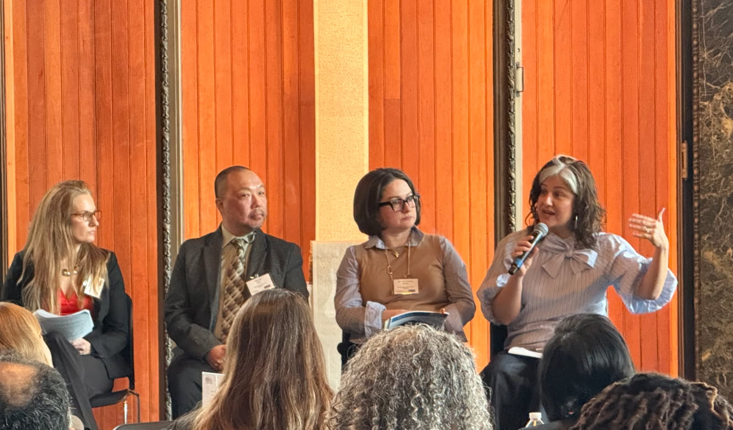
Pictured from the left: Dr. Rebecca Vonderlack- Navarro, Latino Policy Forum; Dr. Kiljoong Kim, Chapin Hall; Dr. Teresa Ramos, Illinois Department of Early Childhood; and Executive Vice Chancellor of City Colleges of Chicago and President of City Colleges of Chicago Foundation, Veronica Herrero.
A recent panel discussion hosted by UChicago and the Kersten Institute for Urban Education brought together perspectives from educators representing Chalmers Elementary School and Hubbard High School, along with researchers from IWERC, the UChicago Consortium, and the Kersten Institute for Urban Education. It also featured a panel discussion that included City Colleges of Chicago’s (CCC) Executive Vice Chancellor and Foundation President, Veronica Herrero.
Panelists discussed the complex challenges that youth and families navigate that affect students’ attendance, school connection, and overall well-being. Panelists emphasized that factors such as mental health needs, family responsibilities, housing instability, safety concerns, and other pressures can all influence whether students are able to consistently attend, focus, and achieve in school.
“When we are discussing education policies, I keep high in my mind, our parenting students…with our partners like Greater Chicago Food Depository and Cook County Health, we are able to create value for our students. We expect our parenting students to go to school, forego wages and still put food on the table, get their degree and find a job all while parenting. It’s a big task. Together, with our partners, we are working to address this and offer supports like food access and employer connections. We do this because we want our students to feel valued and have a sense of belonging so that they will keep coming back to class and persist.” said Exec. Vice Chancellor and CCC Foundation President Veronica Herrero. “Connecting all our students to careers is so critical and that’s why City Colleges continues to work with employers, building that connection for our students so that they can seamlessly transition into a career of their choice, one that meets their needs and the employer’s need.”
In addition, the conversation highlighted the need for policies and systems that are grounded in the real experiences of students, families, and educators; experiences that support stronger collaboration across education, health, and community sectors. Panelists also stressed the importance of relationship-driven and human-centered strategies—such as access to food, mental health services, and supportive school environments and services— all of which help build trust and belonging.
The full discussion focused on moving beyond siloed systems toward coordinated supports that help students, families, and school communities thrive.